

Summary
- There is no separate legal threshold for ‘high protein’ in Australia. A food needs at least 5 g of protein per serve to make a protein claim, and at least 10 g per serve to be called a ‘good source” of protein [1].
- A protein label can come at a price. A 2026 CHOICE audit found that products promoting protein cost around 50% more per 100 g than their regular equivalents [2].
- Compare per 100 g, not per serve. Serve sizes vary between products, so the per 100 g column gives the fairest comparison.
- The ingredients list shows where the protein comes from. Ingredients are listed in descending order of ingoing weight [3].
- Meals matter more than snacks. Around 25–30 g of high-quality protein per meal is linked to the strongest muscle-building response [4].
Walking down a supermarket aisle today, it is hard to miss the word ‘protein’. It appears on yoghurts, breakfast cereals, snack bars, pancake mixes, chips and even instant coffee. The number of high-protein options can be overwhelming, and the label on the front of the pack does not show whether a product is genuinely higher in protein, or worth the extra cost.
In some cases, the difference from the regular version is small. In a 2026 audit of 175 supermarket products, CHOICE found that products promoting protein cost around 50% more per 100 g than their regular equivalents. In one comparison, a protein-labelled feta contained 18.8 g of protein per 100 g, compared with 17.0 g in the regular version, at a 19% higher price [2].
As an Accredited Practising Dietitian at Marley Spoon, I set the nutrition criteria for our High Protein range. In this guide, I explain what ‘high protein’ actually means on an Australian food label and how to read the nutrition information panel to choose products that are worth paying for.
What are the rules for protein claims in Australia?
Protein claims on Australian food labels are regulated by the Australia New Zealand Food Standards Code. Schedule 4 sets the conditions a food must meet before it can make a claim about protein [1]:
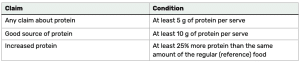
The Code does not set a separate threshold for ‘high protein’, so a product labelled ‘high protein’ does not have to contain any more protein than the minimum needed for any protein claim. It also does not set any condition for protein quality.
For context, the recommended dietary intake (RDI) for protein is 64 g per day for men and 46 g per day for women aged 19–70, rising to 81 g and 57 g respectively for adults over 70 [5]. A product containing 5 g of protein per serve therefore provides around 8–11% of the daily RDI for an adult under 70. That can be a useful contribution, but it is a modest one.
How to read a protein label: 6 Dietitian tips
1. Compare protein per 100 g, not per serve
The nutrition information panel lists values both per serve and per 100 g. Serve sizes vary between products and brands, so a product can appear higher in protein simply because its serve size is larger. The per 100 g column uses the same reference amount for every product and gives the fairest comparison.
Practical tip: When comparing two yoghurts, cereals or bars, look at the protein per 100 g column first.
2. Compare with the regular version
A protein claim tells you that a product meets the minimum condition. It does not tell you how much more protein it contains than the standard version, or how much more it costs. In the CHOICE audit, protein-labelled Greek yoghurt contained 9.3 g of protein per 100 g, compared with 4.8 g in the regular version, but cost 86% more per 100 g [2]. Some products deliver a meaningful increase in protein, others deliver a small one.
Practical tip: Check the unit price on the shelf label (price per 100 g) alongside the protein per 100 g, and compare both with the regular version.
3. Read the ingredients list
Ingredients must be listed in descending order of ingoing weight [3]. When milk, eggs, meat, fish, legumes or soybeans appear near the top of the list, much of the protein comes from the food itself. When ingredients such as whey protein isolate, milk protein concentrate, soy protein isolate or protein crisps appear, protein has been added to increase the total.
Added protein is not necessarily a concern. It does, however, indicate that the product has been formulated to reach a protein target, rather than being naturally rich in protein.
Practical tip: Look for whole-food protein sources in the first few ingredients.
4. Check what comes with the protein
A protein claim describes only one nutrient. Protein-labelled snacks, bars and baked goods can also be high in added sugars, saturated fat or sodium. Reviewing these values per 100 g, along with dietary fibre, gives a more complete picture of the product’s overall nutritional quality. If similar products in the same food category both carry a Health Star Rating, it is a quick way to compare them, as it takes sugars, saturated fat, sodium, fibre and protein into account.
Practical tip: Treat a protein biscuit or bar as a snack food first, and a source of protein second.
5. Consider whether it is a meal or a snack
Around 25–30 g of high-quality protein in a meal is the amount shown to maximally stimulate muscle protein synthesis, the process of building new muscle. High-quality proteins contain all the essential amino acids the body needs, and include meat, fish, eggs, dairy and soy [4]. A snack providing 10 g of protein can be a useful top-up between meals, but it is unlikely to replace a protein-rich meal.
Practical tip: Build each main meal around a protein source, and use protein snacks to fill gaps rather than to meet most of the day’s needs.
6. Don’t overlook whole foods without a claim
Many protein-rich foods rarely carry a protein claim at all. Eggs, yoghurt, milk, cheese, tinned fish, chicken, lean red meat, tofu, lentils and beans all provide protein, along with other nutrients such as iron, zinc, calcium, vitamin B12 or fibre, depending on the food.
Practical tip: Before paying extra for a protein-labelled product, consider whether a whole food could provide the same protein for less.
How Marley Spoon’s High Protein range sets a clear standard
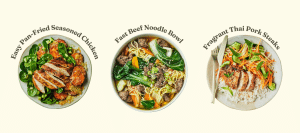
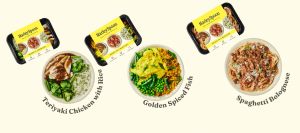
To ensure high-protein claims are meaningful, Marley Spoon sets its own strict protein thresholds. I set the nutrition criteria for our High Protein range, and every recipe is reviewed and approved before it earns the label:
- Meal kits: more than 40 g of protein per serve, four times the 10 g condition for a ‘good source’ claim.
- Ready meals: more than 30 g of protein per serve.
- Breakfast and convenience items: more than 10 g of protein per serve.
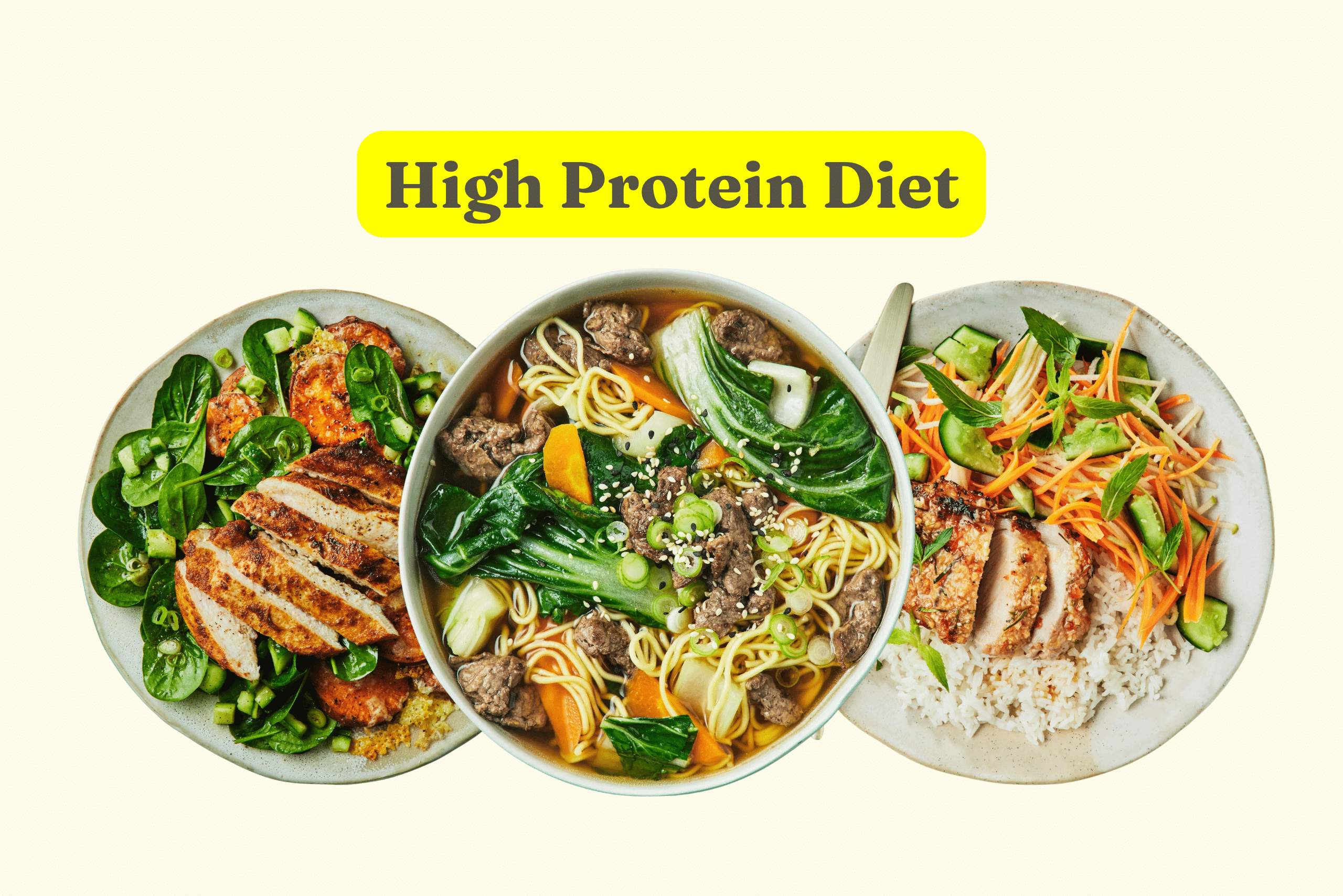
Each week, there are at least 130 High Protein recipes, including vegetarian single-serve options, and around 20 ready-to-heat meals*. Protein is built alongside vegetables and wholegrains, rather than as a larger portion of meat on its own, and the protein per serve is shown on every recipe card and in the app.
A protein claim tells you that a product meets a minimum standard, not that it is the best choice. Comparing protein per 100 g, checking the ingredients and the regular version, and building meals around protein-rich whole foods are the most reliable ways to get value for money from protein.
*Weekly recipe options vary depending on the plan type selected, with 2-person and 4-person plans featuring a larger selection of recipes than other plans.
This is general information, not personal advice. People with kidney disease or following a medically supervised diet should speak with their GP or an Accredited Practising Dietitian before increasing their protein intake.
References
- Food Standards Australia New Zealand. Australia New Zealand Food Standards Code – Schedule 4 – Nutrition, health and related claims [Internet]. Canberra: Federal Register of Legislation; 2024 [cited 2026 Oct 28]. Available from: https://www.legislation.gov.au/F2015L00474/2024-10-29/2024-10-29/text/original/epub/OEBPS/document_1/document_1.html
- CHOICE. How much is the protein premium costing you? [Internet]. Sydney: CHOICE; 2026 [updated 2026 Sep 8; cited 2026 Oct 28]. Available from: https://www.choice.com.au/food-and-drink/nutrition/food-labelling/articles/how-much-is-the-protein-premium-costing-you
- Food Standards Australia New Zealand. Australia New Zealand Food Standards Code – Standard 1.2.4 – Information requirements – statement of ingredients [Internet]. Canberra: Federal Register of Legislation; 2025 [cited 2026 Oct 28]. Available from: https://www.legislation.gov.au/F2015L00392/2025-09-02/2025-09-02/text/original/epub/OEBPS/document_1/document_1.html
- Paddon-Jones D, Rasmussen BB. Dietary protein recommendations and the prevention of sarcopenia. Curr Opin Clin Nutr Metab Care. 2009;12(1):86-90. doi: 10.1097/MCO.0b013e32831cef8b
- National Health and Medical Research Council; Australian Government Department of Health and Ageing; New Zealand Ministry of Health. Nutrient reference values for Australia and New Zealand: protein [Internet]. Canberra: NHMRC; 2006 [cited 2026 Oct 28]. Available from: https://www.eatforhealth.gov.au/sites/default/files/2022-10/n35-protein_0.pdf